Student Staff Spotlight | Q&A with Cecilia Ledezma
Cross-posted on the DSI website
by Lauren Brace
DISCO’s Undergraduate Program Assistant, Cecilia Ledezma, discusses her role within The DISCO Network’s Search Engines programming series.
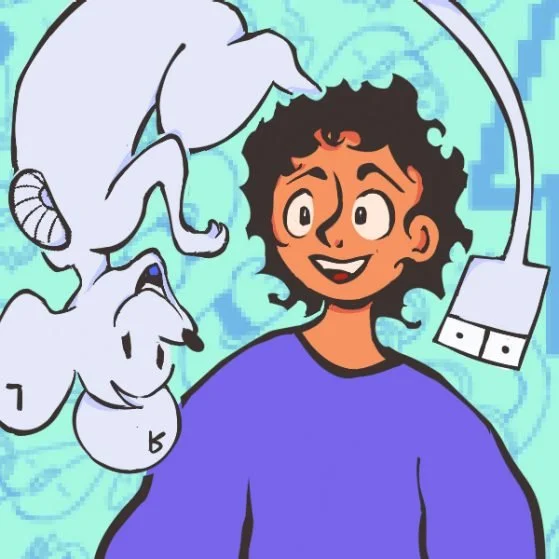
Image: Cecilia Ledezma
Cecilia Ledezma works as the Undergraduate Program Assistant for Search Engines, a programming series that focuses on the intersection of art, tech, and justice, which is funded by the U-M Arts Initiative and housed in the Digital Studies Institute. In her free time, she can be found creating drawings of animals and friends on MS Paint with a trackpad. In the following Q&A, Cecilia shares her research interests and her favorite Search Engines events, including the Search History Zine Launch Parties. [Responses have been edited and condensed for clarity.]
What attracted you to the Digital Studies Institute and the DISCO Network?
I was attracted to the DSI after taking the introductory course to the Digital Studies minor, DIGITAL 202, “Digital Culture” with Dr. Toni Bushner. Through the Honors Program, I was able to set up a project working with Dr. Bushner and go more in-depth into the class topic. I was really interested in how video games create narratives, and at the end of the class, I got to give a big presentation about queerness in video games. In addition to completing the Digital Studies minor, Dr. Bushner asked if I was interested in applying for a position within the DSI, so this has become a great way for me to be more involved with the Institute.
Tell me about your area of study and your research interests.
The big thing I'm working on right now is my Capstone in Research through the English Honors program. I am writing a thesis that critiques the dark academia genre and subculture. Half of it is dedicated to The Secret History by Donna Tartt, and the other half engages with the social media aspect of dark academia. I’m investigating how Pinterest, Tumblr, Instagram, and YouTube users interact with both the medium, the source materials, and one another in relation to class and appearance. I've borrowed a lot from the research that I've done with Dr. Bushner, investigating social media interactions and other content I learned in her class, DIGITAL 258, “Fanfiction, Theorycrafting, and Prosumer Communities,” to do my analysis of social media content.
I'm fascinated by analyzing social media posts. I think a lot of people don't realize all of the scholarship that goes into analyzing something that we see in abundance every day.
Absolutely, I think that's what originally drew me into Digital Studies. As someone who's both a writer for The Michigan Daily’s Digital Culture beat and someone who has been online consuming art for the longest time, I knew that there was something really interesting to be studied on social media. There is so much to say about online ways of engaging, not just with media, but with one another. I think that scholarship on it is super productive, and communities’ ethnographies have never been easier to document, especially with the way social media works. Whereas before we would have to physically intrude on community spaces, now we can enter them as observers online, and there's a wealth of content to be analyzed.
Tell me about Search Engines; what are Search Engines’ mission and themes?
Search Engines centers around the intersection of art practice, emerging technology, and social justice. What that means for us is we want to platform individuals and projects that exist in those fields—we have the speaker series in which we invite artists, technologists, and justice organizations to come to campus. I've helped advertise and moderate events. I think that these Search Engine events are some of the coolest experiences at our university, and I’m really grateful to be a part of them.
There's always something to learn. The panelists are always so excited to share their work with you. One of the best things I’ve found is that if you stick around at the end, nine times out of ten, they’re happy to talk with you further. And if it’s a topic that you end up loving, then you’ve just made a contact who’s an expert in the field.
What have been some of your favorite Search Engines events?
The first one I ever helped with was the “Asian Futures, without Asians” event with Astria Suparak. It was about Orientalism in science fiction, and it was a phenomenal talk. Another one I really enjoyed was Molly Soda’s interactive workshop, “I <3 Files,” where we went through her process. She encouraged us to make works of our own, which was super interesting, especially because she’s such a prolific artist.
I have to say that my favorite events have been the Search History Zine Launch Parties. I came up with an idea to do a zine exchange, and then asked, “Why don't we put together a zine and get submissions from people in Digital Studies and beyond, who are interested in the intersection of art, tech, and social justice?” It's been such a blast not just to create the first one and put a website together, but then get to do it again. Watching us evolve with a theme was really magical and important to me. I’m very proud of the work we've done.
For the first zine launch party, I made little Victorian-style folded love letters, which you would have to open up to get a QR code and information about the event. We could have just done a poster, but we decided to do something more fun. This job encourages me to think outside the box, using my creativity to make something new and unexpected.
What were the Zine launch parties like?
For the launch parties, we invited contributors, friends of contributors, and people just interested in looking at some cool art. Contributors were able to showcase and present their work, while everyone got to leaf through a physical copy of the zine. While it's all on the website, I think there's something special about holding things in your hand. For the most recent launch, we had four panelists, two in person and two over Zoom, which meant that the physical location wasn’t a hindrance for people to have the opportunity to talk about their work.
What is one thing regarding art, tech, and justice that you wish everyone knew?
This is going to be a weird one, but I think it's fun. The Wikimedia Commons is an accessible tool for everyone. You can just go there to download an image, and if you check their copyright availability, more often than not, you can use and remix it however you want. We talk a lot about copyright, which is important for protecting artists, but it's also important to know that there's a huge breadth of images, music, and video that are out there for you to use.
What does a typical day online look like for you?
A typical day includes going through three different social media apps—Tumblr, Instagram, and TikTok, trying my best not to get stuck in the YouTube Shorts hole. I send my friends a lot of images and memes, and download edits for my partner to see. I’m also an international student, so I spend a lot of time texting and staying in touch with my family. I also open Google Docs a lot and sometimes play MahjongSoul online.