Banff Book Jam 2026 Recap
By Giselle Mills
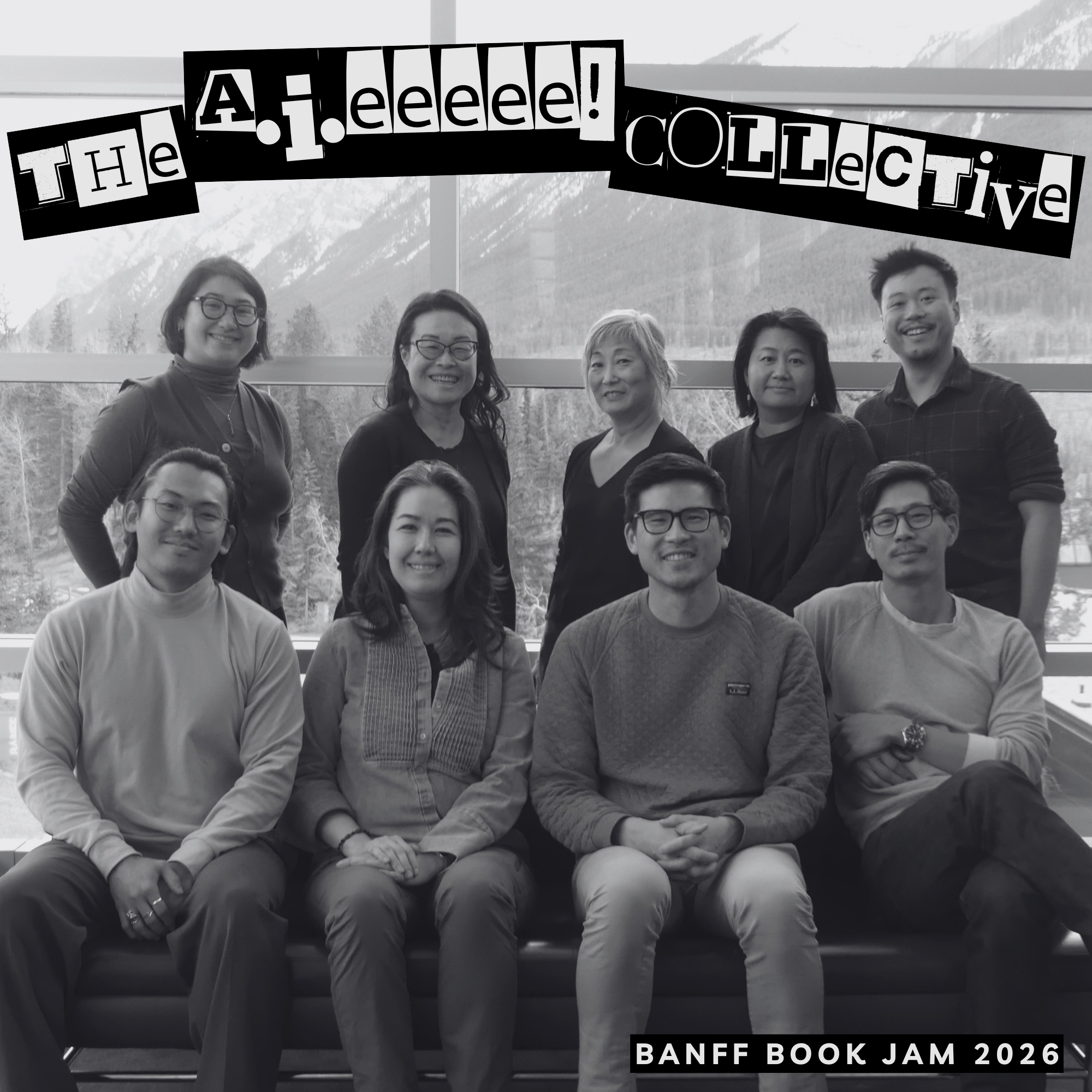
Image Credit: Cherice Chan & Giselle Mills
In the beginning of May 2026, 9 interdisciplinary scholars traveled to the Banff Centre in Banff, Canada for a DISCO Network Book Jam, a 5-day collaborative writing retreat. The authors, Brian J. Chen, Julie Chu, Jasmine Lee Ehrhardt, Tara Fickle, Huan He, Grace Kyungwon Hong, Paul Kim, Lisa Nakamura, and K. Ian Shin, were joined by facilitators Faith Bosworth and Stephanie Rosen and DISCO Network staff members Cherice Chan and Giselle Mills. The culmination of these 5 days was a new, collaboratively written monograph: Feeling the Future: Asian/Americanist Takes on Techno-Empire (under review at Stanford University Press). Four months later, in the midst of publication review, we asked 3 of the authors about the process and what they learned.
[The following responses have been edited for length and clarity.]
Q. What was the most rewarding or valuable part of the Book Jam for you?
Paul Kim, [UC Santa Barbara, PhD Candidate in Film and Media Studies]: The most rewarding part for me was being taken so seriously by so many scholars I have admired for so long! I had a bit of imposter syndrome going into the Book Jam, but the way it's structured requires everyone to not only trust each other's work but their own as well. I grew a lot in my self-confidence as a scholar, knowing that my work would be taken seriously by people I respect, while also feeling empowered to engage with their work as an editor as well. The senior scholars also did a ton of heavy lifting, often taking the tasks that required a bit more expertise. I felt cared for as a junior scholar, but also treated like a peer, which is such a blessing.
Tara Fickle [Northwestern University, Associate Professor of Asian American Studies]: Getting to work with folks I wouldn’t have the opportunity to cross paths with normally, especially non-academics and those working in other disciplines, having a smooth-running infrastructural support team that allowed me to focus entirely on writing, and being able to draw on timely examples and case studies from others, and observe and learn from other peoples’ thought processes.
Ian Shin [University of Michigan, Associate Professor in American Culture]: Two aspects of the Book Jam stand out as being rewarding and valuable—one intellectual and one practical. Intellectually, it was a joy to be in conversation with and to learn from my co-authors, who all brought with them different backgrounds and methodologies to approach our shared question. The Book Jam was the very model of interdisciplinary collaboration. Practically, the Book Jam allowed me to truly disconnect from my day-to-day commitments, to find time for focused thinking and writing, and, most of all, to approach that work with intentional imperfection. By "intentional imperfection" I mean that I learned to take risks and let go of work-in-progress, trusting that my collaborators would take my ideas and transform them into something deeper and more compelling. The idea that something I wrote on day one of the Book Jam would be completely unrecognizable by the end of the week became exciting and liberating. A large—perhaps indispensable—part of that has to do with the expert staffing that Giselle and Cherice provided, as well as the facilitation and editorial support by Faith and Stephanie and Helen. The Book Jam simply would not have been possible without them, and if I had them in my life more consistently I'd probably be a lot more productive!
Q. How do you see the Book Jam and the collaborative writing process impacting your future work, research, or methodology?
Paul Kim: The Book Jam was a huge influence on how I see my future scholarship and collaborative research activity. I am currently in the job application process and have been thinking a lot about what I would like to accomplish with research funds/infrastructure. A large part of what I would like to do in the future is a multi-year long series of workshops and trainings across the humanities and computer science that would culminate in a week-long collaborative book-writing session. I'm really interested in cross-disciplinary training and foundation building, as a data science-trained humanities scholar. Experiencing the Book Jam allowed me to envision what kinds of written projects could emerge out of these sorts of longer-term interdisciplinary collaboration.
Tara Fickle: It already has! I am currently finishing a solo book manuscript and employed the iterative process of drafting and then going back to do “final passes,” as well as allowing another set of eyes on it earlier on. The resulting revision has been noticeably stronger and more cohesive, plus it has sped up the process considerably and helped me maintain momentum even in times of frustration. I have learned more about how non-academic readers read — or at least the particular habits of our one non-academic co-author — and it’s been very helpful in how I revise my own work now to be more accessible and public-facing. (A specific example is avoiding the more overt signposting we’re often taught to deploy: i.e. “As discussed earlier” or “I will argue that”). The Jam taught me a ton about the importance of a conducive, aesthetically pleasing physical environment, including both exercise and nature: how much more productive, counterintuitively, it makes you.
Ian Shin: At heart, I am still a historian, and to some extent this was one of the most challenging aspects of the Book Jam—but also one that most impacted my scholarly process. We historians like to spend months, if not years, in the archives poring over every last possible scrap of historical evidence. Freeing myself of that possibility because we were in the beautiful Canadian Rockies with nary an archival box in sight, I learned to write in a way that is more hypothesis-driven and freer—but no less rigorous.
Q. If you could go back to day 1 of the Book Jam, what is one thing you would tell yourself?
Paul Kim: Everyone is super nice and you have nothing to be scared about! Also try to go outside more than one day out of the week.
Tara Fickle: Trust the process. Be patient with yourself and others. It’s natural to feel nervous: it’s like summer camp. Enjoy the outside environment as much as you can: take walks, smell the air, go shopping in town, take the bus to nearby attractions. Don’t feel guilty about it. Recognize that pleasure as PART of the work, not an escape from it.
Ian Shin: I was constantly amazed by the breadth of my collaborators' knowledge and their experiences. If I could go back and do it all over again, I would want to tell myself to read more, watch more, and listen to more things related to our topic before the Book Jam, just to prepare my mind for the kind of expansive thinking that I would be doing for the week.
Join us in-person or online for our "Feeling the Future: Asian/Americanist Takes on Techno-Empire, Chinamaxxing, & the 'American Century of Humiliation'” event on Wednesday, September 23, 2026, featuring authors Brian J. Chen, Julie Chu, Jasmine Ehrhardt, Paul Kim, and Lisa Nakamura.
Read our new Book Jam Report available now on the DISCO Network website.